HYPERSIM is the culmination of 20 years of collaborative research involving Hydro-Québec, Réseau de Transport d'Électricité (RTE), and the China Electric Power Research Institute (CEPRI). Since 2010, OPAL-RT has continued to drive the development of HYPERSIM. HYPERSIM 6.0 features an advanced Windows®-based modeling environment. Supporting standard Intel-compatible multi-core computers and all of OPAL-RT's advanced FPGA-based real-time I/O systems, HYPERSIM is a real-time digital simulator capable of simulating and analyzing ultra-large power systems with up to 2000 three-phase buses. Leveraging an open architecture, high-speed parallel processing, and modular scalability to deliver standard real-time simulation, this level of performance achieved through standard computer technology far exceeds that of other high-cost digital real-time simulators utilizing custom DSP and RISC processor boards. HYPERSIM has consistently remained at the forefront of innovation and has become standard equipment in national laboratories, industry R&D centers, and power utilities across the United States, Asia, and Europe. It is used for factory acceptance testing, system integration testing, research and development work, and commissioning tests.
Powerful Power Grid Simulation Capability
Create real-time power system models with thousands of three-phase buses on a single simulator without compromising electromagnetic transient accuracy.
High-Speed Processing and Communication
In terms of processing power, inter-processor communication speed, and scalability, HYPERSIM runs on OPAL-RT's standard Intel-compatible multi-core computer systems.
Power Electronics Simulation Models
Provides a wide range of easily configurable power electronics models tailored to the needs of the power industry, enabling co-simulation with FPGAs to execute high-fidelity power electronics models at sub-microsecond time steps.
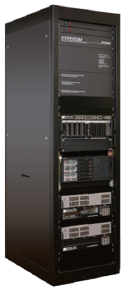
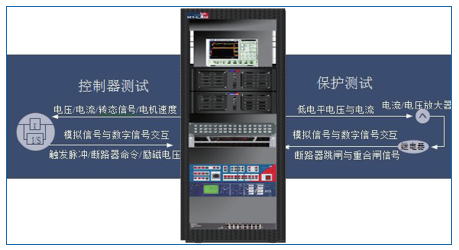
HYPERSIM comprises hardware and software components. The system can perform offline simulations using single or multiple processors on a workstation, or real-time simulations using OPAL-RT's OP5600 series simulator hosts. Its applications include: controller testing, protection device testing, and studying interactions between HVDC and FACTS systems. It features the following characteristics:
■ Extensive library of power system and power electronics components
Common power system components such as generators, motors, transformers, transmission lines, distribution lines, and loads; power electronic devices; voltage/current sensors; Virtual IEDs and relays.
■ Interface with MATLAB/SIMULINK/SPS
■ Support for user-written C code/libraries; ability to import EMTP-RV network data

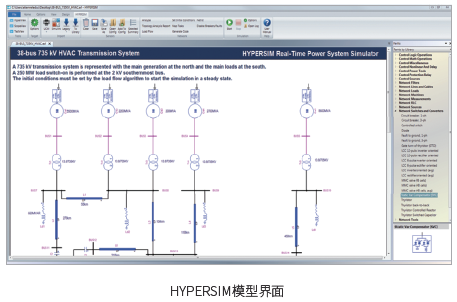
Users can build power grid models, configure component parameters, add measurement points, utilize MapTask for automatic task assignment, control simulation start/stop, and perform online parameter tuning. HYPERSIM provides an accurate power flow analysis module that establishes steady-state conditions for the power system based on power/voltage reference values and automatically initializes the power system. Advanced interpolation techniques enable users to accurately simulate valve firings that occur between two simulation time steps.
■ Automatic core distribution for parallel simulation computation on licensed cores
■ One-click code compilation and execution
■ Advanced interpolation technology for accurate simulation of valve firings occurring between time steps
■ Support for importing MATLAB/Simulink models
■ Support for user-defined C code modules and calling encapsulated libraries

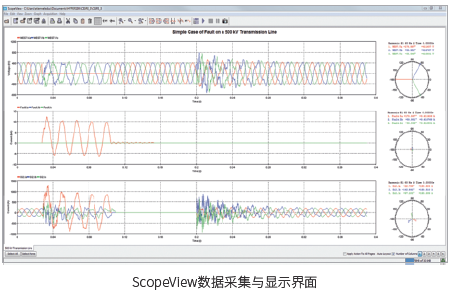
ScopeView is data acquisition and signal processing software used for visual analysis of HYPERSIM simulation results. It can import data from EMTP-RV, MATLAB, and Comtrade; offers advanced post-processing capabilities such as calculating maximum/minimum values, average values, FFT, harmonic analysis, etc.; and can generate test reports.
■ Visualization waveform interface and processing for simulation results
■ Capable of performing mathematical operations, frequency domain response, spectral density, and other numerical processing
■ Waveform manipulation and processing suitable for generating reports and paper results
■ Can read data source files in formats such as MATLAB, CSV, COMTRADE, etc.

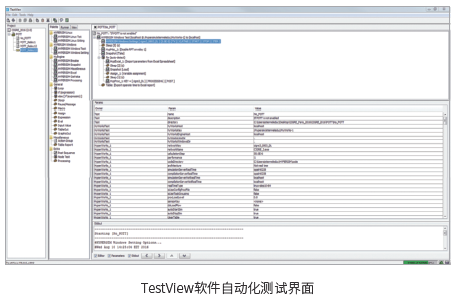
■ Allows users to write and execute automated test cases
■ Performs thousands of data statistics, random Monte Carlo tests, continuous day/night cycle tests, etc.
■ Stores simulation data in standard formats for offline analysis.
■ Open application programming interface
■ Automated generation of test waveforms and data reports
■ Automated data processing of test results (e.g., calculating maximum current values from thousands of runs)
HYPERSIM is suitable for real-time testing of large-scale power systems featuring thousands of three-phase buses. Customizable computers and communication boards offer competitive solutions for enhancing simulation capability.

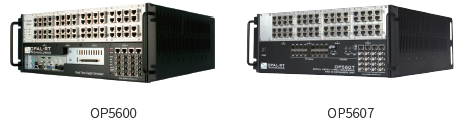
OP5600 Real-Time Simulator Host
■ 8/16/32/64 cores at 3.46 GHz, Xilinx FPGA (Spartan 3 or Virtex 6)
■ Real-time operating system (Linux Red Hat) and powerful I/O processing capabilities
■ Up to 128 analog I/O channels or 256 digital I/O channels, or a combination thereof
■ Connection to external devices via DB37 connectors
■ I/O monitoring on the front panel
■ Up to 4 PCI slots
■ Supports third-party I/O communication protocols: IEC61850, UDP/IP, CAN, ARINC, MIL1553, IRIG-B, DNP3.0, C37.118, etc.
OP5607 Real-Time Simulator Host
■ Up to 128 analog I/O channels or 256 digital I/O channels, or a combination thereof
■ 4U chassis, includes one Virtex 7 FPGA card
■ PCIe x4 (20 Gbps) communication interface

The HYPERSIM software can also be integrated with the OP7000 chassis and I/O systems, utilizing multiple FPGA boards to achieve high-precision simulation of voltage source converters with microsecond time steps.
HYPERSIM Power System Real-Time Simulation System
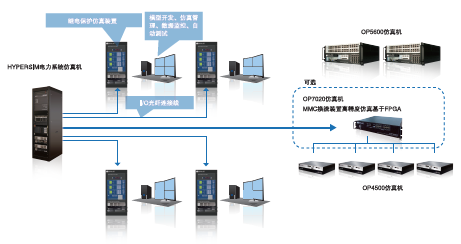
The diagram below shows a typical HYPERSIM power system real-time simulation system. It includes 2 OP5600 real-time simulators and 1 OP7000 (FPGA) simulator, with an optional OP7020 (FPGA) simulator to expand the system with 4 quad-core OP4500 simulators. The system connects to the user's control and protection devices via the remote I/O interface of the OP7000 simulator, using SFP high-speed fiber optics for communication to ensure system real-time performance. Users can perform real-time monitoring of the system through a user workstation.

Hardware-in-the-Loop Testing of Controllers and Protection Systems
■ Functional and performance testing of controllers and protection systems
■ Testing of complex SCADA systems
■ FACTS dynamic performance testing
■ Closed-loop testing of relays and auto-reclosing devices
■ Integration of HVDC converters and FACTS in large-scale AC transmission systems
■ Research on new technologies, such as MMC-HVDC converters and their analysis when connected to actual power grids
■ Reducing controller commissioning time and enabling more effective control strategy design
■ Power Hardware-in-the-Loop (PHIL) testing for high-voltage equipment
Power System Studies
■ Voltage analysis, dynamic analysis, and system stability analysis for AC and DC power systems
■ AC-DC power system interactions
■ Electromagnetic transient analysis for fault conditions, line changes, or ferroresonance
■ Analysis of custom power equipment and FACTS devices such as STATCOM, SVC, and TCR
■ Study of contingency events under various conditions
■ Power generation, transmission, and distribution
■ Smart grids
■ Distributed energy resources, such as photovoltaic arrays, wind turbines, synchronous machines, and fuel cells
Higher Education and Training
■ Practical resource for training personnel involved in power system protection and control
■ Training for operators and technicians on emergency procedures
■ Applied courses in universities

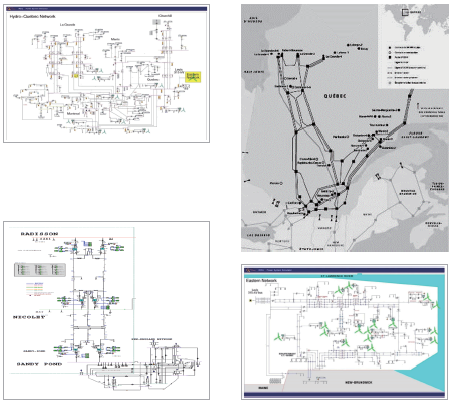
Quebec HVAC/HVDC Transmission Simulation System
This system simulates the actual Quebec AC/DC transmission system in Canada. The transmission grid voltage level is 230 kV, and the simulation scale includes 780 three-phase nodes. It incorporates detailed models of 25 large-scale wind farms in the Quebec region, 7 SVCs with their controls, and one 3-terminal HVDC transmission system. The HVDC transmission control operates using actual control and protection devices connected to the simulation.
HYPERSIM enables electromagnetic transient real-time simulation of considerably large-scale power transmission systems. It can incorporate thousands of power system components, perform power flow analysis, automatically allocate tasks, and dynamically tune power parameters, providing a more mature and reliable solution for large-scale transmission systems.